Robotics

Robo-Forming Digital Twin

An advanced and intelligent manufacturing pipeline for Roboforming — a flexible, low-cost, software-controlled alternative to both traditional and CNC forming, targeted currently at prototyping and low-volume, high-mix applications.

Heavily rigid and high-payload-capacity robots are used conventionally for robotic incremental forming. Contrary to that, this work aims to use low-payload collaborative robots on opposite sides of the sheet — enabling far better geometric accuracy and lesser forming forces, integrating AI-based force-controlled path planning. The result is a far cheaper, more accessible, and more deployable forming setup.

After designing and manufacturing the custom fixture, the path is planned with both the robot's own planner and with the target of a custom AI-informed forming path planner. The whole pipeline is now being finalized and tested with ROS 2 to make Roboforming parametric and flexible.

Outcome: CAD-to-Forming pipeline, ready to implement. Reduced the forming forces by 70% through a better trajectory planner. The pipeline is parametric and adaptable to any manipulator, and path planning is fully automated.

Toolkit Applied SolidWorks · Abaqus · Polyscope · URScript · Python · ROS 2 · MoveIt · Gazebo · IK Solvers (Trac-IK) · Trajectory Planners (OMPL, Pilz, TrajOpt) · Custom Path Planner
Sim
Real
Conical part shaped by twin cobots, side view
Front view of finished conical part on the rig
Robo-forming digital twin: physical rig paired with the simulated toolpath, alongside finished conical parts.
Quality Inspection

In-Line Inspection Automation

A three-tier automation rollout for a major automotive client's production and assembly inspection workflows — built on integrated edge computer vision and deployed successfully.

Tier 01
In-line integration
Custom camera hardware and inspection software installed directly into the client's existing in-line system — bringing digital capture, traceability, and structured inspection records to a previously manual workflow.
Tier 02
Semi-automated inspection
Operator-assisted decisioning: edge-deployed AI models flag defect candidates in real time; an operator validates the final pass/fail. A practical bridge between manual review and full autonomy.
Tier 03
Fully autonomous inspection line
Closed-loop hands-free production inspection. The actual deployment is under NDA and cannot be shared publicly — shown opposite is a simplified build concept illustrating the workflow.
Applied Toolkit Basler industrial cameras · Industrial X-ray & CT inspection · Edge computer vision · Machine vision integration · Blender (synthetic data & simulation) · xis.rt · Python
Simplified build concept — actual deployment under NDA
Mechanical Design · Test Engineering

Hydraulic Test Bench

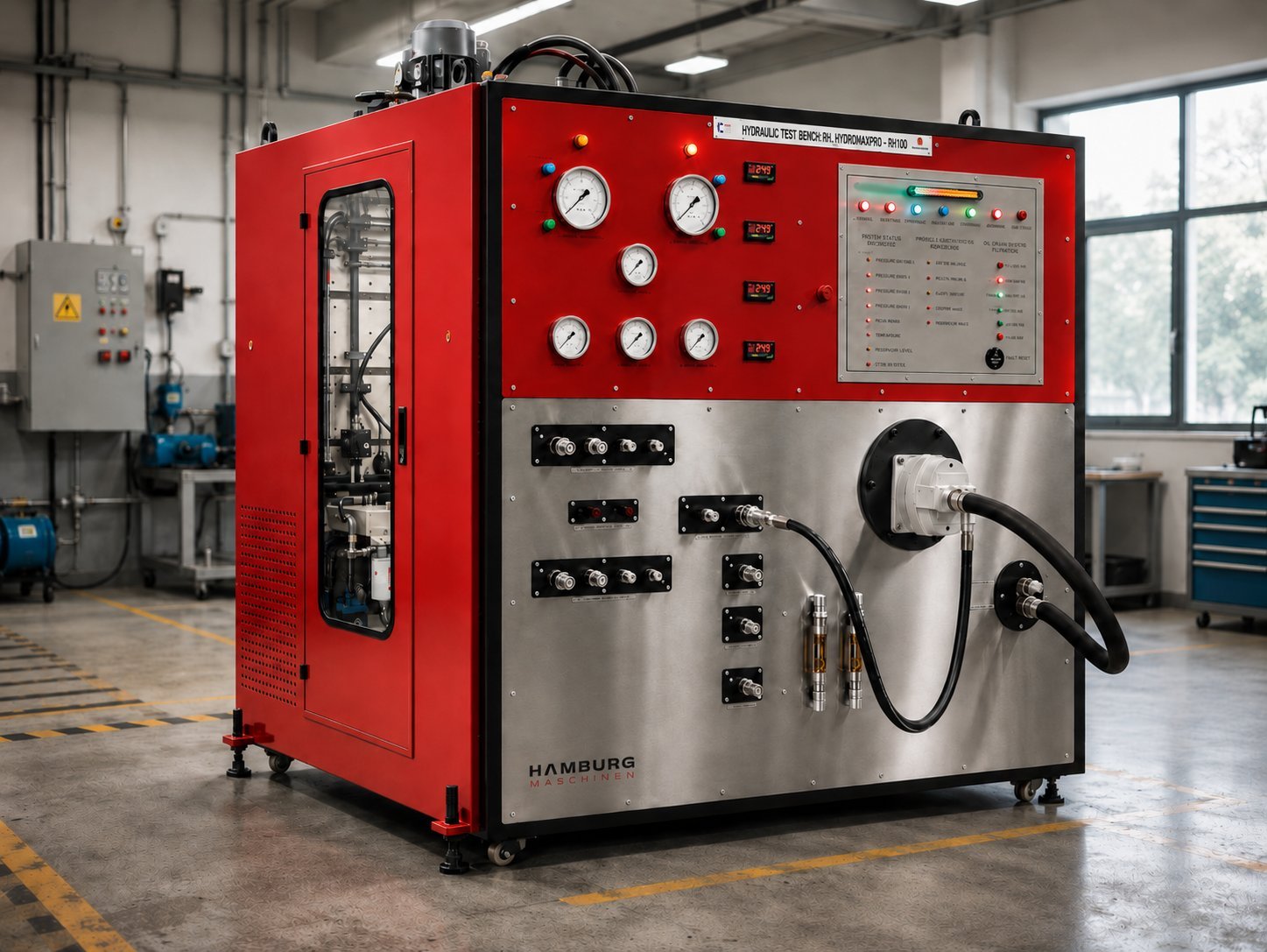
Mechanical design and structural validation for the HM-120 250B-55 — a high-capacity, servo-driven hydraulic test bench by Hamburg Maschinen, capable of testing hydraulic pumps, valves, hoses, and assemblies up to 120 LPM at 250 bar.

I designed the mechanical enclosure, hydraulic plumbing layout, and instrumentation panel, and validated the frame structurally under continuous operating loads.

I also contributed to the bench's automation: a 55 kW AC servo-driven pump drive with closed-loop speed and load control, an integrated pilot hydraulic circuit for smooth DCV actuation, and digital instrumentation alongside analog gauges. Hands-on work spanned NI cRIO and LabVIEW Real-Time for sensor data acquisition (pressure, flow, temperature) and automated test sequencing across pump, valve, and hose validation workflows.
Tools & Stack SolidWorks · ANSYS Mechanical · NI cRIO · LabVIEW Real-Time · Industrial hydraulics
HM-120 hydraulic test bench
Final assembly — rendered visualization.
SolidWorks assembly model of the hydraulic test bench
SolidWorks CAD model — full assembly tree.

More projects will be uploaded soon.

Let's build something worth building.

Thinking together is difficult, but building together is something I believe in.

Get in touch →